
In old-fashioned British English ‘a wireless’ was a radio, as simple as that. We often forget how groundbreaking this invention was. Radio waves are always in the air and people still listen to the radio in their car, at home or when they walk or sport. The first radio I remember as a child was an old, now called ‘vintage’ Blaupunkt radio. We were happy to have an uncle that sold radios and television sets in a town nearby and I loved to enter his shop and look at the new models that were on sale. In the seventies in Belgium a lot of high quality brands on sale were made in Germany: Grundig, Blaupunkt, Dual, Saba, Siemens, Telefunken, Braun and a brand that remained a standard in quality Sennheiser.
In my life I have always been intrigued by languages and technology. I studied languages and my first job was in a multilingual environment working in an international transport company doing business administration in English, French, German and Dutch. In that time I even learnt how to send a telex! A wonderful machine that made a lot of noise.
The telex was the technology part I liked and at some point when the business was not going so well anymore | looked for another job in administration, but I didn’t like that very much either, so when I got the opportunity to work as a salesman in Fnac, the audio-hifi department, I took it. I was fascinated by those new emerging technologies the company offered and when a shop opened in Ghent and they were looking for salespeople interested in technology I applied for the job and started working there in 1988.
A couple of years before I went to listen to one of the first CD players by Philips. That was in Brussels during my military service, 1982 or 1983. At that time I was a fan of Funky Town, a radio program with Guy De Pré. It was broadcased by Radio 2- Omroep Brabant and the FM reception in Brussels was excellent.
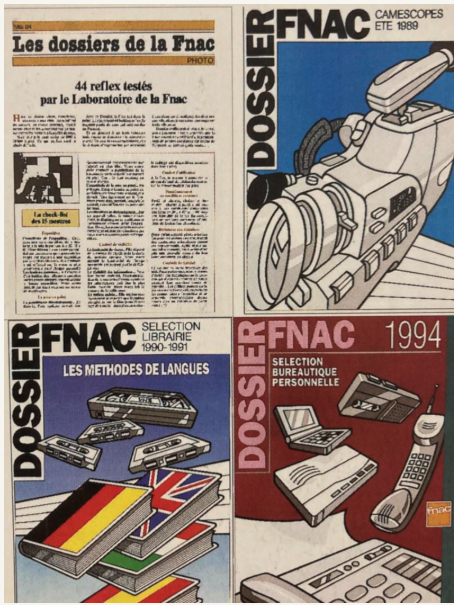
I worked in the Fnac shop in Ghent for 18 years and in the early years I did my first translation job from French to Dutch of the ‘dossiers techniques’.
A day I remember very well was the visit to the Labo Fnac in Paris.
The Labo Fnac is the testing and review laboratory for high-tech products, established by Fnac in 1972.
Located in Massy, in the Paris region, it is renowned for its independence and the rigor of its tests, which cover a wide range of products: smartphones, headphones, televisions, cameras, computers, and many more. The results are published on the Fnac and L’Éclaireur Fnac websites, as well as in stores, to help consumers make informed choices. (ref. https://leclaireur.fnac.com/article/cp64153-70-ans-de-la-fnac-histoire-du-labofnac-testeur-independant-des-nouveautes-technologiques/)
Early wireless pioneers Herz, Lodge and Marconi focused on transmitting electromagnetic waves through the air. Nikola Tesla however is the “Father of the Wireless”
The book “The True Wireless” by Nikola Tesla is a seminal work in which Tesla presents his revolutionary ideas about wireless transmission of energy and information. Originally published as an article in the Electrical Experimenter magazine in May 1919, Tesla challenges the prevailing Hertzian wave theory and outlines his own approach to wireless technology, which he believed was far superior and more powerful. In this work, Tesla is often referred to as the “Father of the Wireless” and discusses the principles that underpin modern wireless communication and even predicts technologies like remote control and Wi-Fi decades before they became reality (ref.
http://www.tfcbooks.com/tesla/1919-05-00.htm)
I liked working in Fnac very much. It gave me a lot of satisfaction to help people choose the best walkman, transistor radio, radio-cassette, ghettoblaster or even Yamaha or Roland synthesiser keyboard. I checked the What hi*fi magazine or the german “Stereo” and read a lot of books and magazines about electronics. I had a particular interest in shortwave radio because it fascinated me how it was possible to listen to radio programs that came from other continents like Asia, Southern America or Africa. There was no internet yet, so for e.g. flemish expats in Africa from Belgium listened to the RVI
‘Radio Vlaanderen Internationaal’. To be able to listen to that radio station you needed a very good shortwave radio and I sold a lot of Sony ICF-SW7600 to our customers.
When I was about 12 years old I wondered what these letters UKW meant (Ultrakurzwelle). Later I understood it had something to do with the lenght of the waves. In fact UKW = FM, Frequency Modulation or VHF, Very High Frequency.
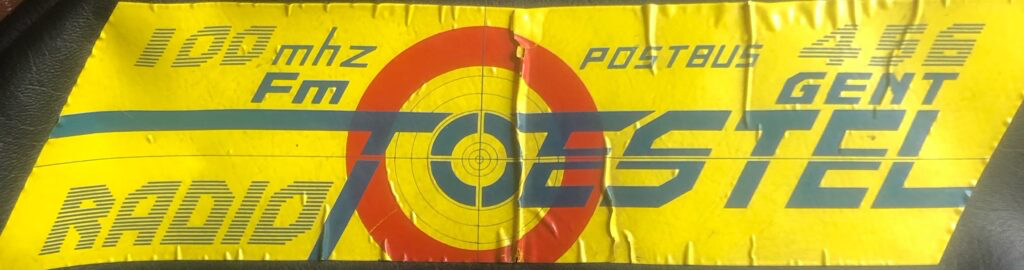
To listen to a certain radiostation you have to tune to a certain frequency. In the time before internet radio you had to find your favourite radiostation tuning to ‘your’ frequency.
A couple of years later when I was studying languages in Ghent
Ghent that was the Radio Toestel frequency



